Showing posts with label X-ray crystallography. Show all posts

Saturday, 8 October 2011

Wait - you're doing ANOTHER three years of University?

My PhD is in Biophysics. Yeah, biophysics. I normally get the following response:


Starting only this week, I'm still finding my feet in the lab where I'm working, and I'm only beginning to scratch the surface of the mountains of literature which are pertinent to my (impenetrable)PhD title: 


G-protein regulation phosphoinositide 3-kinase conformation and dynamics in signal transduction, autophagy and cellular sorting.


Or to paraphrase:


Cancer. 

Because, eventually, everything you learn in biochemistry will, in some way, and at some time be made applicable to cancer.


In all seriousness though, this PhD is actually relevant to cancer. The main focus of my study are phosphoinositide 3-kinases (PI3 Kinases for short), which are pretty interesting little enzymes. Kinases are enzymes which phosphorylate - i.e. tag a phosphate group onto a target. The target of PI3 Kinases being a molecule of fat - called phosphatidylinositol - which is part of the cell membrane.


Phosphorylation is a big deal in biochemisty. It's how everything gets done. Attaching a phosphate group to an enzyme is the atomic equivalent to flicking a molecular switch (although not necessarily onto the "on" position). Phosphate groups consist only of a handful of atoms, but can radically change the workings of a entire enzyme -consisting of many thousands of atoms. These little phosphate achieve these enzymatic adjustments by altering the local electrostatic environment fairly drastically - causing a of modification to the shape and dynamics of protein, fundamentally responsible for any changes in activity. It's these very small, very negatively charged bundles of atoms which can ultimately change the fate of the cell and , by extension, the organism as a whole i.e you and me.


A diagram of a G-protein (or more accurately a G-protein coupled receptor (GPCR).*

Back to PI3 Kinases though. Changing cell activity is ultimately down to signalling, such as sending a hormone from the pancreas, through the blood stream to the  cells in question. Signals from outside the cell however have to somehow manage to  effect the internal workings of the cell. Some signals can just saunter in across the cell membrane, if they're small and of the correct charge. Many of the larger signals, like hormones, however have a specific protein with is a receptor sticking out of the cell membrane - and that's where the "G-protein" part comes in. G-proteins are a class of cell receptors which span the cell membrane, allowing the translation of signals which were received on the external face of the cell membrane to be transmitted into signals inside of the cell. G proteins only function when they are bound to their own unique highly specific signalling molecule - their ligand. 


G-proteins are a HUGE deal in biochemistry. More time and effort around the world goes into understanding G-proteins than many people care to imagine. Some are fairly well understood, whilst others are complete black boxes of understanding. One fairly well understood G-protein is rhodopsin, the protein responsible for all that vision you take for granted.


The general outline for this kind of signalling is the following:


signal binds to G-protein on the cell surface-> G-protein binds to PI3 Kinase inside of the cell -> activates PI3 Kinase -> PI3 Kinase phosphorylates lipid


So now you know what the G-proteins and phosphoinositide 3-kinase and singal transduction bits of the PhD title are about. As for the autophagy and cellular sorting I'm still in the dark about them.


*Image credits: http://rsc.riken.jp/eng/st_bio/process.html 

Thursday, 26 May 2011

I'm an x-ray something something.

Telling people you're a biochemistry student is often greeted with a mixture of a non-committal head movement and a slow but determined escape. More foolhardy people then go on to ask what I actually do, given I’m working in industry at the moment, and I cough out an answer along the lines of ‘X-ray crystallography’, which is normally causes their face to have a flash of frustration - I think that people believe I am trying to be obstructive or aloof for the sake of appearing mysterious. The main problem when explaining X-Ray crystallography is that it’s hard to be succinct and in any way true to the subject at the same time. Also another problem is that, as a student, most of the time I have no idea what exactly I am doing.  


Ribosome structure determined by X-ray crystallography from Venki Ramakrishnan
  What I do have some idea about however is the end result of X-ray crystallography; a model of a protein molecule or a nucleic acid– a very, very detailed model.

In the very best models, consisting of hundreds or thousands of amino acids, single atoms of each amino acid can be discerned – giving an amazingly complex model of the protein totaling tens of thousands of atoms. Navigating and orientating yourself around such a vast and detailled model is difficult enough, but producing such a thing is far, far more difficult. So, why would you want to expend so such time and effort on producing such a model of a protein or a nucleic acid?

Producing these models - although innately intricate and beautiful - isn't an end in itself. These models are capable of telling us vast amounts of information on how the proteins work and interact with other proteins. A detailed-enough model can describe the mechanism of an enzyme's catalysis to the atom; something which reminds me of how astounding this field of science is. There is something both unsettling and supremely comforting when a process is understood in such detail that we understand it on the most fundamental level.

However, achieving these models is anything but easy. A whistle-stop tour towards a model would go something like this;

Firstly, there is the matter of producing enough protein in order to examine it via crystallography. This involves (normally) knowing the genetic sequence, and implanting the gene into our good old friend E.coli. There's all sorts of issues here, such as your protein falling apart (degradation), or clumping together (precipitation/aggregation) or the protein simply being insoluble. 

Secondly, there's the small matter of purifying the protein. There's a few thousand proteins in E.coli which you won't want to look at, and so finding a method of extracting your protein of interest is an art in itself. Methods generally rely on the concept of chromatography, a method of separating a mixture of stuff based on its affinity to something else. Being able to produce a large amount of pure protein isn't simple nor easy, and this step alone can take an inordinately large amount of time. 

Pretty...
 Third, there's the crystallography. Taking your high-purity protein and producing crystals requires a skill somewhere between alchemy and magic. It involves screening your protein against hundreds (to thousands) of different solutions. There's all sorts of frustrations to be found here with two near identical solutions able to give widely different results. Protein crystals are typically less that a millimetre long, and some grow in horrible solutions at 4 degrees centigrade - which makes harvesting them not so much fun. They also like fragmenting apart when you touch them and they also like no being exposed to the air for any amount of time. They're fussy little twats. Very small nylon loops are typically used to manipulate and play with them. Before the last step, the crystals are frozen in liquid nitrogen to about -150 degrees centigrade to stop them being damaged prior to diffraction.


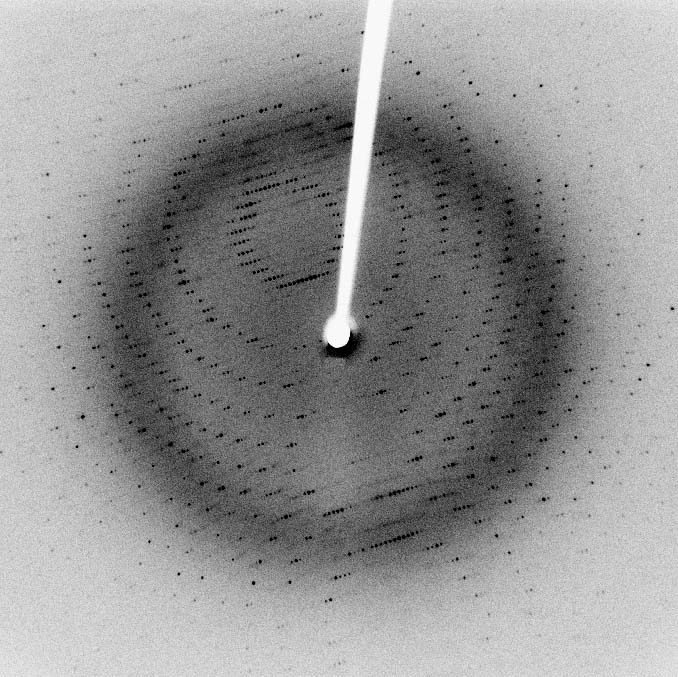
Diffraction patterns aren't particularly accessible.
  Finally, you diffract your crystal using X-Rays, to produce a diffraction pattern - something between a Rorschach test and a join-the-dots pattern. Using a reasonable amount of computer power and complex mathematics (including Fourier Transformation)these images can be analysed and used to produce one of those lovely models I was talking about. Between a gene and a protein model is (on average) a year of tears, blood, swearing and sweat.

It's not a particularly romantic process, and it's not really completely comprehensible. But somewhere between the complex maths, and the thousands of crystallisation trials, the end product seems justified.